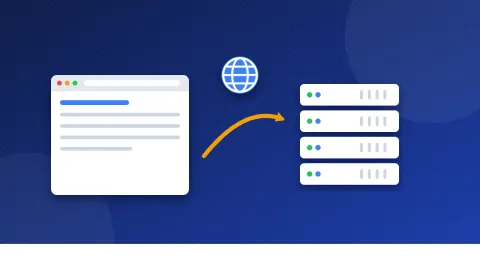
The simplest way to explain domain name vs web hosting: the domain name is your website's address, and web hosting is the house where your site's files live. People type the address to find you. The host keeps the house open and sends your pages to them. A normal website needs both.
Beginners mix the two up all the time, partly because many companies sell both on one checkout page. This guide pulls them apart in plain words, so you know what you pay for and what to watch.
What is a domain name?
A domain name is the name people type to reach your site, like bloghints.com. Computers find each other with number addresses called IP addresses. A domain is an easy word that stands for that number.
You never really buy a domain forever. You rent it, usually one year at a time, and you renew it to keep it. As long as you keep renewing, nobody else can use that name.
What is web hosting?
Web hosting is space on a server, a computer that stays online all the time. Your pages, images and database live there. When someone visits your domain, the server sends them the files that make up your page. You pay the host by the month or by the year. Our guide on what web hosting is covers this in more detail.
What is the difference between a domain name vs web hosting?
Here are the two side by side:
| Point | Domain name | Web hosting |
|---|---|---|
| What it is | The address | The house for your files |
| Who sells it | A registrar | A hosting company |
| How you pay | Usually yearly | Monthly or yearly |
| If it stops | Nobody can find your site | Your site has nothing to show |
The two connect through DNS, the Domain Name System. DNS works like a phone book. Your domain's settings tell DNS which server holds your site. If that link is missing, the address leads nowhere.
Registrar vs host: who does what?
A registrar is a company allowed to rent out domain names to the public. It records you as the owner and lets you change the domain's settings.
A host runs the servers. It stores your files, runs your database and keeps the site online.
Many companies do both jobs. That is why you often see "free domain" offers with hosting plans. Even then, they are two separate products with two separate renewal dates.
The setting that joins them is the nameserver. Cloudflare explains that nameserver (NS) records tell the internet where to find a domain's IP address. When you set your domain to use your host's nameservers, the host's DNS can point visitors to your site. Our step-by-step guide shows how to point a domain to hosting.
Should you buy them together or separately?
Both ways work. Each has good and bad sides.
Buying both from one company
- Easy setup: the domain often points to your hosting on its own.
- One bill and one login.
- A free first year of the domain is common with hosting plans.
- The catch: if you leave the host later, moving the domain takes an extra step. And if one account has a problem, both may be affected.
Buying them from different companies
- More freedom: you can change hosts by updating your DNS settings. The domain stays where it is.
- Less risk: a billing or account issue at the host does not touch your domain.
- The catch: two bills, two logins and one extra setup step.
For a first blog, buying both together is fine. As your site grows, many people move the domain to a separate registrar for peace of mind.
How do renewals work?
Both products renew on their own dates. A "free domain" usually means free for the first year only. After that, it renews at the normal price. Hosting deals work the same way: a low intro price, then a higher renewal price.
Turn on auto-renew for both and keep a working card on file. Also keep your contact email up to date. ICANN, the group that oversees domain names, requires registrars to send two renewal reminders, about one month and one week before the domain expires. Those reminders only help if they reach an inbox you read.
What is WHOIS privacy?
When you register a domain, you give the registrar your name, email, address and phone. In the past, much of this showed up in a public directory called WHOIS. Anyone could look it up, and spammers did.
Many registrars offer a privacy or proxy service that shows their details instead of yours. Some include it for free, and some charge for it, so check before you buy. The lookup system has also changed. Since 28 January 2025, ICANN uses a newer system called RDAP in place of WHOIS for generic domain endings such as .com. You can try it with the ICANN Lookup tool.
What happens if one of them expires?
If the domain expires
Your site and any email on that domain can stop working right away, even if your hosting is paid. ICANN describes two grace periods. Some registrars keep the domain for an auto-renew grace period of 1 to 45 days, during which you can still renew. If the registrar deletes it, you get a 30-day redemption period to restore it, often for an extra fee. After that, anyone can register your old name.
If the hosting expires
Your domain still belongs to you, but it now points to an empty or suspended account. Visitors see an error or a host's warning page. Many hosts keep your files for a short time and then delete them. Each host sets its own rules, so check yours. Always keep your own backup, so a missed payment does not cost you years of work.
Which mistakes should you avoid?
- Using an old email address for your domain account.
- Thinking a "free domain" stays free forever.
- Letting a web designer register your domain in their own name.
- Turning off auto-renew and forgetting the date.
- Keeping no backup outside your host.
To sum up domain name vs web hosting: the domain is the address, and hosting is the house. Rent each from a company you trust, link them with DNS, and keep both renewed. If you are still choosing a host, our checklist on how to choose web hosting for a new blog can help.
Frequently asked questions
Can I have a domain without hosting?
Yes. You can own a domain and leave it unused, or forward it to another site. To show your own website on it, you need hosting or a site builder that includes hosting.
Can I move my domain to another registrar?
Yes. You turn off the transfer lock, get a transfer code from your current registrar and start the transfer at the new one. Your site keeps working during the move if your DNS settings stay the same.
Is a free domain with hosting a good deal?
It can be, as long as you know the renewal price. The free part normally lasts one year. Make sure the domain is registered in your name, so you can take it with you if you leave the host.