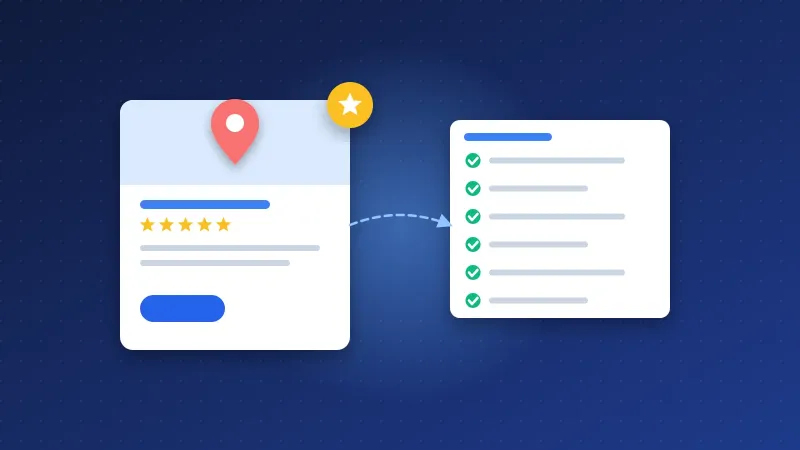
Google Business Profile vs. local directories: which first? Set up and verify your Google Business Profile first, because it is the listing customers see in Google Search and Maps, and every other listing should copy its details. Then add Apple Maps, Bing Places and the main directories over the next few weeks, using exactly the same name, address and phone number.
This guide gives a new local business a simple week-by-week order, explains which directories feed other platforms, and shows how to measure whether it is working.
Google Business Profile vs. local directories: which first, and why?
Google Business Profile (GBP) is the free listing that shows your business in Google Maps and in the local results on Google Search. A local directory is any other site that lists businesses by location, such as Yelp, Yellow Pages-style sites or your chamber of commerce.
GBP comes first for three reasons:
- It is where most local searches end. Google says local results are based on relevance, distance and prominence. Your profile is the main thing Google uses to judge relevance.
- Verification takes time. Google may ask for a video, phone call or other check. Starting early means you are not waiting later.
- It sets your master details. Once your name, address, phone, hours and categories are final in GBP, you copy them everywhere else. That keeps everything consistent from day one.
Directories still matter. Google's local ranking help page says prominence considers how many websites link to your business and how many reviews you have, and directories are part of how a business becomes known across the web. They just come second.
Which directories feed other platforms?
Some listings matter more because they pass your data on to many other places.
- Bing Places now imports listings from Google, an import Microsoft improved in its 2025 relaunch. Do it after GBP is complete.
- Apple Business Connect controls how you appear in Apple Maps, Siri and other Apple apps.
- Data aggregators are companies that collect business data and send it to apps, car navigation systems and smaller directories. In the US, BrightLocal names Foursquare, Data Axle and TransUnion (formerly Neustar Localeze) as the main ones.
- Big general directories such as Facebook and Yelp are visited directly by customers and often show up in searches for your business name.
For the next layer, our local business directory list groups useful sites by type and country.
A week-by-week setup plan for a new local business
This order works for most single-location businesses. Adjust the timing to your own pace.
| Week | Main tasks | Goal |
|---|---|---|
| Week 1 | Decide your exact NAP and hours. Create and verify Google Business Profile. Pick your primary category. | One verified, accurate profile |
| Week 2 | Complete GBP: description, services, photos, opening hours, website link. Make sure your website shows the same NAP. | A complete profile and matching website |
| Week 3 | Set up Apple Business Connect and Bing Places. Create or claim Facebook and Yelp. | All major maps and platforms match |
| Week 4 | Submit to data aggregators and 5 to 10 big general directories in your country. | Correct data spreading to many sites |
| Weeks 5–6 | Add the top industry directories and your chamber of commerce or local association. | Relevant, trusted local citations |
| Weeks 7–8 | Start a steady review routine. Check every listing for errors and duplicates. | Ongoing reviews and clean data |
A few practical rules for each step:
- Use your real business name. Google's guidelines do not allow extra keywords, taglines or locations in the name.
- Choose the fewest categories that describe your core business.
- Keep a spreadsheet of every listing with its login and the date created.
- Add a UTM tag to the website link in GBP (for example
?utm_source=google&utm_medium=organic&utm_campaign=gbp) so you can see that traffic separately in analytics.
If you also want to list your website in general web directories, start with a short, well-chosen set from our free directory list instead of mass submissions.
How important are reviews and photos?
Very. Reviews affect both rankings and whether people choose you. BrightLocal's Local Consumer Review Survey 2026 found that 97% of consumers read reviews for local businesses, about 74% look for reviews from the last three months, and 80% say they are likely to use a business that responds to all of its reviews.
Simple habits that work:
- Ask every happy customer. Send your GBP review link by text or email soon after the job.
- Reply to every review, good or bad, in a personal way. Generic copy-paste replies look lazy.
- Keep reviews coming. A steady flow beats a burst followed by silence, because recency matters to customers.
- Add real photos regularly: your storefront, team, work and products. Avoid stock images.
- Never buy or gate reviews. Fake reviews break platform rules and can get your profile suspended.
How do you measure calls and visits?
Google Business Profile has built-in performance data for verified profiles. It shows searches, views, calls from the profile, direction requests, website clicks, messages and bookings.
- Check monthly, not daily. Numbers move up and down with seasons.
- Compare month to month and year to year to spot real trends.
- Use your UTM-tagged link to see GBP visits, leads and sales in your website analytics.
- Ask new customers how they found you. It is old-fashioned and still very useful.
Directories rarely give you good data, so judge them by referral traffic in analytics and by whether customers mention them.
For most new businesses the answer on Google Business Profile vs. local directories, which first, is simple: verify and complete Google first, then copy those exact details to Apple, Bing, the aggregators and the directories your customers actually use. That order saves rework and keeps your information consistent everywhere.
Frequently asked questions
Can I build directory listings before my Google profile is verified?
You can, but it is better to wait until your details are final. If verification forces a change to your name, address or category, you will have to edit every directory again. A short wait saves a lot of cleanup.
Do I need a physical address for Google Business Profile?
No. Service-area businesses that visit customers can hide their address and show a service area instead. You still need a real location to verify, and P.O. boxes are not accepted.
How long before a new profile starts getting calls?
It varies with your category, location and competition. Some businesses see calls within the first weeks after verification, while competitive niches may take a few months of reviews and citations. Track your performance data monthly to see the trend.