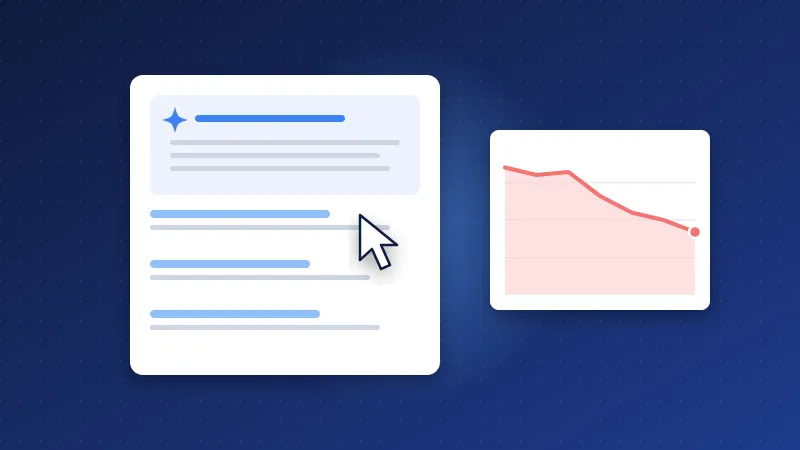
The short version of how AI Overviews changed click through rate for informational queries: clicks fell sharply, and they fell most for pages that are not cited in the overview. Large studies from Seer Interactive, Ahrefs and Pew Research all show lower organic CTR when an AI Overview appears, while pages cited inside the overview keep noticeably more clicks than those left out.
Informational content, the how-to guides and explainers that most blogs live on, sits right in the path of this change. Here is what the research shows and what I would change on a content site because of it.
How AI Overviews changed click through rate for informational queries: the big studies
Three studies are worth knowing. They use different methods, which makes the agreement between them more convincing.
| Study | Data | Main finding |
|---|---|---|
| Seer Interactive (reported April 2026) | 53 brands, 5.47M queries, 2.43B impressions, Jan 2025 to Feb 2026 | Organic CTR about 3.3% without an AI Overview, 2.1% when cited, 0.9% when not cited |
| Ahrefs (February 2026) | 300,000 keywords, Dec 2023 vs Dec 2025 Search Console data | Position one CTR about 58% lower when an AI Overview is present |
| Pew Research Center (July 2025) | Browsing data from US adults, March 2025 | Users clicked a traditional result in 8% of visits with an AI summary vs 15% without |
Ahrefs' figure is worth noting for its trend: its earlier study, published in April 2025, measured a 34.5% drop. The effect grew as the feature rolled out more widely and people got used to reading the summary instead of clicking.
Seer's data adds a more hopeful detail. Organic CTR on queries with AI Overviews bottomed out at about 1.3% in December 2025 and climbed to about 2.4% by February 2026. Two months is too short to call a recovery, but it suggests the decline is not a straight line.
Pew also found that people were more likely to end their browsing session entirely after seeing an AI summary, 26% of visits compared with 16% without one, and that only about 1% of visits included a click on a link inside the summary.
Cited vs. not cited pages
The Seer numbers make the most practical point. On a results page with an AI Overview:
- A cited page gets roughly 2.1% CTR, about two thirds of the no-overview baseline.
- An uncited page gets roughly 0.9%, under a third of the baseline.
In other words, for an informational query that triggers an AI Overview, being cited is worth more than double the clicks of ranking without being cited. Rank still matters, but it is no longer the whole story. A page in position three that is linked inside the overview can out-earn the page in position one that is not.
Which query types lost the most clicks?
AI Overviews do not appear evenly. According to Seer, they showed on about 95% of comparison searches and 86% of question searches, but only about 5% of transactional ones. Pew found the same shape from a different angle:
- Searches phrased as questions triggered an AI summary 60% of the time.
- Searches of 10 words or more triggered one 53% of the time.
- One- or two-word searches triggered one only 8% of the time.
That points to the content most exposed: definitions ("what is a nofollow link"), simple how-tos with a short answer, and comparisons. Queries where the reader needs to do something on a site, such as buying, signing up, downloading or using a tool, are much less affected. Lists and resources people use rather than read, like a directory list or a tools collection, also hold up better because a summary cannot replace them.
Checking your own Search Console numbers
You do not need a large dataset to see the effect on your own site. Google counts AI Overview traffic inside the normal Web search type in Search Console, so you compare patterns rather than filter for it.
- Pick five to ten informational pages that have ranked steadily for at least a year.
- Compare the same months year over year to avoid seasonal noise, looking at impressions, clicks, CTR and average position per query.
- Flag queries where position held but CTR dropped. If position is stable and CTR falls by a third or more, an AI Overview is the likely cause.
- Search those queries by hand to confirm an AI Overview appears and check whether your page is cited.
- Split your list into cited and not cited and compare CTR between the two groups.
On most content sites I would expect a pattern similar to the studies: stable or rising impressions, lower clicks on question-style queries, and a clear gap between cited and uncited pages. Your exact numbers will depend on your niche.
Adjusting your content strategy
- Write to be cited. Answer in the first two or three sentences, add a short standalone summary, and use question headings that match real searches.
- Go deeper than the summary. The overview covers the basic answer. Pages that keep clicks offer what it cannot: checklists, worked methods, comparison tables, templates and current lists.
- Rebalance your topic mix. Fewer thin definition posts, more practical resources and tools people bookmark and return to.
- Measure differently. Track impressions and citations alongside clicks, and watch engagement and conversions per visit, not only traffic totals.
- Keep building authority. Pages that are well linked and widely referenced are more likely to be trusted as sources, so steady backlink work still pays off.
The research on how AI Overviews changed click through rate for informational queries is consistent: fewer clicks overall, and a clear advantage for cited pages. The sites that adapt best will make their pages easy to quote and worth visiting even after the reader has seen the summary.
Frequently asked questions
Do AI Overviews reduce traffic for every type of search?
No. They appear mostly on informational, question and comparison searches and rarely on transactional ones. Pages built around buying, signing up or using a tool are much less affected than short-answer explainers.
Is it still worth writing informational content?
Yes, but it needs to go beyond what a summary can give. Informational pages still earn impressions, citations and links, and pages with original methods, tables or resources keep more clicks than thin definition posts.
How can I tell if an AI Overview is costing me clicks?
Look in Search Console for queries where your average position stayed stable but CTR dropped noticeably. Then search those queries yourself to see if an AI Overview appears and whether your page is cited in it.