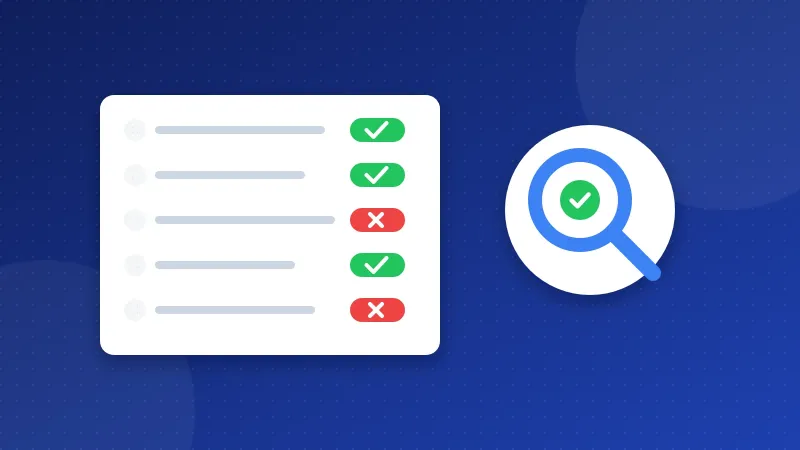
To check if a page is indexable, paste its URL, or a whole list of URLs, into the Bulk Indexability Checker. Bloghints' server fetches each page and reads the signals that tell Google whether it may index it: the status code, redirects, robots.txt, noindex tags and the canonical tag. Each URL gets one verdict, Indexable or Not indexable, with the reason.
What makes a page indexable?
Google's index is its big list of pages that can show up in search results. A page is indexable when nothing on your side keeps it out of that list. In practice, that means four things are true:
- The page answers with status 200, which means "OK".
- Your robots.txt file does not block it.
- It has no noindex rule in a meta robots tag or in an X-Robots-Tag header.
- Its canonical tag points to itself, or there is no canonical tag at all.
Indexable does not mean indexed. It only means the door is open. Google still decides if a page is worth adding. To see what Google really did with a page, use Search Console, as our guide on checking if a page is indexed in Google shows.
What the Bulk Indexability Checker reports
For every URL in your list, the checker shows these signals side by side:
| Signal | What you see |
|---|---|
| HTTP status | The code the server sent, such as 200, 301, 404 or 500 |
| Redirect chain | Every hop and the final URL |
| robots.txt | Whether a rule blocks Googlebot or all bots |
| Meta robots and X-Robots-Tag | Any noindex or nofollow rule, and where it was found |
| Canonical | Self, another URL, or missing |
| Title | The page title, so you can tell pages apart |
| Verdict | Indexable or Not indexable, with the reason |
You can filter the list by verdict, so only the problem pages show. The full results can be exported as a CSV file for a spreadsheet.
How do you check if a page is indexable?
- Collect your URLs. Copy them from your sitemap, your CMS or a Search Console report.
- Paste them in, one URL per line, with the full https:// address.
- Run the check and wait while the server fetches each page.
- Filter by "Not indexable" and read the reason on each row.
- Fix the cause on your site, using the steps below.
- Check the same URLs again to confirm the verdict changed.
How to fix each "Not indexable" reason
The page returns an error or redirects
A 404 or 410 page does not exist, so Google drops it. If the page should be there, restore it or point the old address to the new one. A 5xx code means the server had an error, which is a job for your host. A redirect is not an error, but the indexable page is the final URL, not the one you pasted. Update your links and your sitemap so they point straight to the final address.
Blocked by robots.txt
A Disallow rule in robots.txt tells bots not to fetch the page. Google cannot read a page it is not allowed to fetch. That also means a page blocked by robots.txt cannot show its noindex to Google. The URL can even appear in search results without a description if other pages link to it.
So pick one tool for one job. To keep a page out of search, allow crawling and add noindex. To open a page that should rank, remove or narrow the Disallow rule. Our guide to robots.txt for beginners explains how the rules match URLs.
A noindex rule
Noindex can sit in two places. One is a meta tag in the page's head, such as <meta name="robots" content="noindex">. The other is an X-Robots-Tag header that the server sends, often set in .htaccess or by a plugin. Common causes are a WordPress setting that hides the site from search engines, a per-post option in an SEO plugin, or a rule left over from a test site. The guide on soft 404, noindex and blocked pages covers more cases.
Nofollow is different. It tells Google not to follow the links on the page, but on its own it does not keep the page out of the index.
The canonical points to another URL
A canonical tag says "the main copy of this page is over there". Google usually indexes that other URL and leaves this one out. That is right for true copies, such as a print version. It is wrong when a theme puts the homepage as the canonical on every post, or mixes http and https. Read the canonical tag explained to set it up. A missing canonical is not an error, but a canonical that points to the page itself is a clear signal.
Signals checked, not Google's own index
This tool reads what your server sends. It does not ask Google, so it cannot tell you if a page is really in the index or why Google chose to leave it out. Pages can pass every check here and still wait a long time.
On my own sites, many old articles stayed unindexed for years, even though I linked to them from other posts. Some new articles got indexed quickly, and I never found out why. Ruling out a technical block is the first step, and this tool does that for a whole list at once.
Once your list is clean, make sure your sitemap holds only indexable URLs. The XML sitemap generator skips noindex and redirected pages for you.
Run a check after every redesign, plugin change or site move, because that is when stray noindex tags and bad canonicals sneak in. Check if a page is indexable before you ask Google to index it, and you will not waste requests on pages that tell Google to stay away.
Frequently asked questions
Why is my page indexable but not in Google?
Indexable only means nothing on your site blocks the page. Google still decides what to add, based on things like quality, duplicates and how it found the page. Check the URL in Search Console to see Google's own status and reason.
Can Google see a noindex tag on a page blocked by robots.txt?
No. If robots.txt blocks the page, Google never fetches it, so it never reads the noindex tag. To remove a page from search, allow crawling in robots.txt and keep the noindex tag until the page drops out.
Does nofollow make a page not indexable?
No. Nofollow tells Google not to follow the links on that page, but it does not stop the page itself from being indexed. The checker still shows it, so you can spot a nofollow rule you did not mean to set.